


Vision and learning
"Learning" problems are often visual problems
 If children are struggling with reading they should be taken to see a developmental optometrist who will evaluate the child to determine if the "learning" problem is in fact a visual problem. Note that some learning problems are cause by bona fide learning disabilities that are not connected to the visual system. The latter likely cannot be treated with vision therapy. It is important to rule out vision as an obstacle to learing.
A large amount of scientific evidence supports the connection between vision and learning. Many of the relevant studies are discussed below. In addition, the American Academy of Optometry released a position paper on the care of the struggling student in August 2013, which summarizes the latest science in easy to understand language.
It is essential that a child’s visual system function properly because two-thirds of all information we receive is visual and 80% of all classroom learning comes through our visual system. Optometric vision therapy improves vision function and rehabilitates deficiencies and dysfunctions related to visual performance and this in turn improves learning ability.
A student’s visual skills are employed to perform tasks such as reading and using a computer. According to the American Optometric Association, vision disorders affect one in every four school-age children.
While many of these patients have refractive errors that can be treated with compensatory lenses, some have additional problems in the functioning of the visual system that are best treated by optometric vision therapy.
Most students on individual learning plans have a binocular vision disorder
 The evidence on eye problems associated with reading difficulties and learning problems continues to accumulate.
A recent study entitled Association between reading speed, cycloplegic refractive error, and oculomotor function in reading disabled children versus controls published in the May 2012 issue of the journal Graefes Archives of Clinical Experimental Ophthalmology adds to the evidence of the connection between eye and vision problems and learning.
The researchers were struck by the fact that in Ontario, Canada, approximately one in ten students aged 6 to 16 in Ontario have an individual education plan (IEP) in place because of various learning disabilities. May of those learning problems were specific to reading. They wanted to investigate the relationship between reading vision problems and binocular vision problems.
The researchers measured the visual acuity and eye movement measurements of students that had an IEP and compared those results with students in a regular education program.
The researchers found that the IEP group had significantly greater hyperopia, compared to the control group on cycloplegic examination. Vergence facility was significantly correlated to (i) reading
speed, (ii) number of eye movements made when reading, and (iii) a standardized symptom scoring system. Vergence facility was also significantly reduced in the IEP group versus controls. Significant differences in several other binocular vision related scores were also found.
Here is the study's conclusion:
This research indicates there are significant associations between reading speed, refractive error, and in particular vergence facility. It appears sensible that students being considered for reading specific IEP status should have a full eye examination (including cycloplegia), in addition to a comprehensive binocular vision evaluation.
Similar results have been obtained in numerous studies on vision and learning and the positive impact of vision therapy on those with vision related learning problems. For example, a 2010 study published in the journal BMC Ophthalmology found that children with reading difficulties were more likely to have a wide range of visual problems that are effectively treated with vision therapy, such as poorer distance visual acuity, an binocular vision dysfunctions that are effectively treated with vision therapy such as
- exophoric deviation at near,
- a lower amplitude of accommodation,
- reduced accommodative facility,
- reduced vergence facility,
- a reduced near point of convergence,
- a lower AC/A ratio and
- a slower reading speed.
The study confirmed the importance of a full assessment of binocular visual status in order to detect and remedy these deficits in order to prevent visual problems continuing to impact upon educational development.
Vision, learning, reading and vision therapy have been the subject of considerable study
According to the College of Optometrists in Vision Development, "the importance of good vision to reading and learning has been the subject of considerable study. Numerous clinical and research studies have shown that good visual abilities are beneficial to learning to read and to read with understanding. Children with normal eyesight (20/20) can have visual problems which affect how their eyes focus, team together, or move along a line of print when reading."
The College of Optometrists has complies a research summary for those interested in learning more about the science behind vision and learning and the positive impact that vision therapy can have on learning and reading, when deficiencies are caused by vision related dysfunctions. Click here for the research summary on vision, reading and learning.
Example: Reading
Reading is a prime example of a complex visual task that can be impaired by treatable eye movement disorders, especially binocular vision dysfunctions (in which the eyes do not work together properly).
The simple activity of reading requires an individual to use visual abilities such as distance and near acuity, accommodation (eye focusing), binocularity (eye coordination/eye teaming), ocular-motor skills (eye movement), peripheral vision and visual perceptual skills such as figure-ground, form consistency, spatial relations, visual closure, visual discrimination, visual memory and visualization. A deficiency in any one of these areas will cause a child to fall behind. Fortunately, Vision Therapy has proven effective at treating such deficiencies.
According to pediatrician and member of the parent advisory committee of the National Center for Learning Disabilities, Dr. Debra Walhof M.D.,
It is important to remember that normal sight may not necessarily be synonymous with normal vision...That being said, if there is a vision problem, it could be preventing the best tutoring and learning methods from working. Now that certainly doesn't mean every dyslexic child needs vision therapy, however in my opinion, skills such as focusing, tracking and others are essential foundational tools for reading. In general, if your child has trouble with reading or learning to read, getting a vision evaluation to assess these skills from a qualified Developmental Optometrist would be a smart move.
Dr. Walhof is also the parent of a dyslexic child, for whom vision therapy made a huge difference after other treatments and therapies failed.
What It Can Mean When Your Child Says "I'm Stupid"
Information Provided through National Children's Vision & Learning Month Campaign Can Help
AURORA, Ohio, July 18, 2011 /PRNewswire-USNewswire/ -- In honor of August being National Children's Vision & Learning Month, the College of Optometrists in Vision Development takes a moment to focus on vision, learning, and dyslexia.
It can be heartbreaking to see an otherwise bright child start believing he is stupid. What should a parent think when an otherwise happy and confident child makes comments like "I'm stupid" while doing his homework? Especially when his teachers say he is doing well in school.
Jack was one of those children. He would stand up at the table when he was doing his homework. "I would tell him that he had to sit down in the chair. I thought that was really strange," his mother shares. "At first I thought he just didn't want to do his homework and was trying to get out of it. He was not complaining about doing the homework he just kept standing up while looking at his paper. Lots of kids at that age are squarely at homework time."
But, every once in awhile, when he was doing his homework, he began to say, "I'm stupid." This was a big red flag for Jack's mother, who is also a pediatrician. Dr. Debra Walhof shares, "As a pediatrician I work with children enough to know that when a child feels or says 'I'm stupid' they know they are different from the other kids in the class." But why would he say that? His teachers loved him, he had no social or behavioral issues and his class work according to his teachers was great. He was also a very happy and confident kid.
Now the challenge became figuring out what was wrong. Dr. Walhof did what most moms do when their child has a problem… she took Jack to his pediatrician. The pediatrician said that while Jack's distance vision was good, he recommended that Jack get a full vision exam to rule out a vision problem.
The result of the eye exam was surprising. It turns out that Jack was farsighted (meaning he had trouble seeing up close) and glasses were prescribed to help Jack see when he was reading. The optometrist also said that he needed vision therapy for his focusing skills. Jack immediately completed that program.
However, when Jack was in 2nd grade, Dr. Walhof felt that although his work was still fine in school her gut was telling her that something about his learning was different. His teacher told her not to worry, but she was not convinced. Next, Dr. Walhof insisted on getting specialized testing for Jack and the results showed that Jack was Dyslexic. Because he was such a smart kid, he was able to figure out ways to accommodate around his learning disability which is why his teacher thought everything was fine.
At this point Dr. Walhof began a journey that is common for many parents of children with learning disabilities. The journey involves learning about your child's unique learning differences, educating yourself on the various therapeutic modalities as well as learning how to advocate for your child in a complex educational system.
She hired a dyslexic tutor to work with Jack. Dr. Walhof also joined a nine person parent advocacy committee for the National Center of Learning Disabilities in Washington, DC. In addition, Dr. Walhof gathered as much electronic support for Jack as possible, with books on tape, phonetic spell checking and transcribing programs.
But three years later, Jack was still struggling with reading. The dyslexic tutor told Dr. Walhof this was the best he was going to get. While many parents would have given up at this point, Dr. Walhof didn't stop searching. During this time their family moved from California to Oregon, so she took Jack to another developmental optometrist who said Jack could benefit from more vision therapy that would focus on some different areas, such as tracking, that would relate more specifically to his reading.
After completing this second optometric vision therapy program, Dr. Walhof saw definite improvement. "Jack was less tired when reading, his eyes were tracking better and he stopped complaining that his eyes hurt. He also felt more confident in his reading," according to Dr. Walhof. "Optometric vision therapy set the foundation for his eyes to be able to read properly."
Dr. Walhof also found that Jack needed to unlearn what his dyslexic tutor had taught him about how to decode through the language-based method. The language-based method is the predominant method in schools and works for many but not all kids. Dr. Walhof found another method that was more visually-based and after one lesson, the world opened up for Jack. "Understanding that there are many paradigms and that each kid is unique in his learning style and being open to various modalities is key in fulfilling the educational needs of each child. The vision therapy gave Jack the foundational tools he needed to read and the visual-based learning method significantly improved Jack's ability to read."
Dr. Walhof, who has been a pediatrician for 25 years, attributes much of her ability to think outside the box to the Associate Fellowship program she went through in Integrative Medicine at the University of Arizona which was conducted by Dr. Andrew Weil. "His program emphasizes an approach that each patient is unique, that all approaches need to be patient-centered and that no single modality holds all the answers for all the patients."
When asked what advice she would like to give to parents, Dr. Walhof shares, "If you have a child with a learning issue, you cannot rely solely on your child's school. You need to evaluate things yourself. I made a number of mistakes which all parents make, such as deferring to experts even though in my heart I knew they were wrong. If you have a strong feeling something isn't right for your child, it probably isn't and you need to continue searching for a solution. In addition, I learned most of the important information from other parents who were further into this journey with their child."
"It is important to remember that normal sight may not necessarily be synonymous with normal vision…" Dr. Walhof continues, "That being said, if there is a vision problem, it could be preventing the best tutoring and learning methods from working. Now that certainly doesn't mean every dyslexic child needs vision therapy; however in my opinion, skills such as focusing, tracking and others are essential foundational tools for reading. In general, if your child has trouble with reading or learning to read, getting a vision evaluation to assess these skills from a qualified Developmental Optometrist would be a smart move."
Vision is the process of seeing, processing, and acting on the world. Learning is highly affected by deficits in all areas of vision; whether in the acquisition (sight), understanding, or resulting actions. Most "eye" doctors, optometrists and ophthalmologists do not test vision – they test our sight (visual acuity). In order to make sure that your child is being tested for things that can affect learning dramatically, seek out a provider that specializes in visual processing and visual efficiency testing and treatment. Things to get evaluated if your child struggles with any learning difference:
- Visual acuity
- Focusing near to far – speed and ability
- Convergence
- Stereopsis – depth perception
- Tracking – fixation skills, pursuit and saccadic skills
- Visual discrimination
- Visualization
- Visual memory and recall
- Visual motor integration – eye-hand coordination
- Laterality and directionality
August is National Children's Vision and Learning Month and the College of Optometrists in Vision Development invites parents, educators, and physicians to learn more about the vital role vision plays in a child's ability to learn by visiting their website, at www.covd.org.
About COVD
The College of Optometrists in Vision Development (COVD) is an international, non-profit optometric membership organization that provides education, evaluation, and board certification programs in behavioral and developmental vision care, vision therapy, and visual rehabilitation. The organization is comprised of doctors of optometry, vision therapists, and other vision specialists. For more information on learning-related vision problems, vision therapy, and COVD please visit www.covd.org or call 888.268.3770.
CONTACT: Pamela R. Happ, CAE
COVD Executive Director
888.268.3770 tel
Email: phapp@covd.org
Website: www.covd.org
SOURCE College of Optometrists in Vision Development (COVD)
RELATED LINKS
http://www.covd.org
Convergence Insufficiency
Convergence insufficiency is one of the most common vision disorders that interferes with reading. It was recently the focus of a scientific study in the United States funded by the National Institutes of Health and the National Eye Institute - the study found that vision therapy was the best treatment for convergence insufficiency. Convergence insufficiency is a vision problem where the two eyes don't work together in unison the way they are supposed to when one is reading. The result can make reading very difficult.
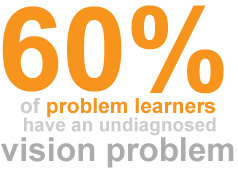
It is estimated that least one out of every 20 school-age children is impacted by convergence insufficiency. However, there are other visual abnormalities to be considered. It is estimated that over 60% of problem learners have undiagnosed vision problems contributing to their difficulties.
The good news is the majority of these vision problems can be treated with a program of optometric vision therapy. The study by the NEI found that in-office vision therapy was the best treatment for convergence insufficiency.
The five most common signs that a vision problem may be interfering with your child's ability to read and learn are:
1. Skips lines, rereads lines;
2. Poor reading comprehension;
3. Takes much longer doing homework than it should take;
4. Reverses letters like b's into d's when reading; and
5. Has a short attention span with reading and schoolwork.
Any one of these symptoms is a sign of a possible vision problem.
 College of Optometrists in Vision Development Research Summary on
vision, reading and vision therapy: a listing of some of the research reports and clinical studies on the relationship of vision to reading and learning ability and the effectiveness of vision therapy in the treatment of learning-related vision problems.
College of Optometrists in Vision Development Research Summary on
vision, reading and vision therapy: a listing of some of the research reports and clinical studies on the relationship of vision to reading and learning ability and the effectiveness of vision therapy in the treatment of learning-related vision problems.
Related Articles:
Eye tracking problems and reading - pursuits and saccades
Wednesday, September 18, 2013
Behaviors in children that indicate a visual-perceptual problem requiring a visit to a developmental optometrists
Saturday July 27, 2013
Research confirms vision therapy can Improve reading comprehension and improve a child's overall attention in the classroom
Friday, July 5, 2013
Visual Input Important in Developmental Dyslexia
Tuesday, July 2, 2013
If your child has reading problems, treatable vision and eye movement disorders may be the reason
Sunday, June 9, 2013
Visual processing and learning disorders
Apr 17, 2013
60% of learning disabled students failed two or more binocular vision tests
Oct 20, 2012
More visual symptoms means lower academic performance
Feb 29, 2012
Vision therapy for convergence insufficiency improves academic performance ...
Jan 16, 2012
82% of teachers report an improvement in students after vision therapy
Jun 16, 2012
Binocular vision dysfunctions ate my homework
Mar 31, 2012
Study proves that vision problems interfere with learning
More visual symptoms means lower academic performance
Feb 29, 2012
Vision therapy for convergence insufficiency improves academic performance ...
Jan 16, 2012
82% of teachers report an improvement in students after vision therapy
Jun 16, 2012
Binocular vision dysfunctions ate my homework
Mar 31, 2012
Study proves that vision problems interfere with learning and cause dyslexia
Apr 25, 2012


